
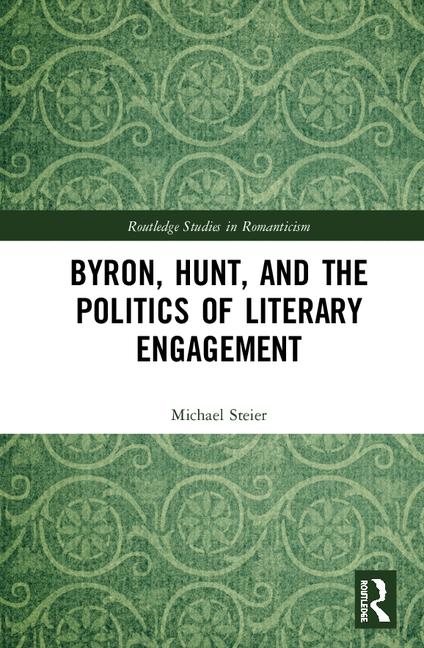
Available from Routledge / Taylor & Francis
Winner of the 2020 Elma Dangerfield Prize
“Byron, Hunt, and the Politics of Literary Engagement . . . demonstrates unequivocally that the friendship between Byron and Hunt has been previously underestimated and oversimplified. An assured performance, this is a hugely enjoyable book.” (Prize Committee of the International Association of Byron Societies)
Read the full announcement here
“There are many works that consider the relationship of Lord Byron and Leigh Hunt, but Steier approaches the topic with a new level of thoroughness. . . . The book as a whole is finely written and densely researched.” (The Year’s Work in English Studies)
Read the full review here
“This study . . . very usefully brings together what we know and new information about this real-life and textual ‘friendship’ and will now become the standard book-length study of it.” (The Byron Journal)
Read the full review here
Byron, Hunt, and the Politics of Literary Engagement is the first full-length study of the friendship and literary relationship of two of the most important second-generation Romantic authors. Challenging long-held critical attitudes, this study shows that Byron and Hunt engaged in a creative and meaningful dialogue at each major stage in their careers, from their earliest published volumes of juvenile poetry and verse satire to their most celebrated contributions to Romantic literature: The Story of Rimini and Don Juan. Drawing upon newly recovered letters and unpublished manuscript material, this book illuminates the surprisingly durable and artistically significant friendship of Lord Byron and Leigh Hunt.
Peer-Reviewed Articles
“Beyond Christ’s Hospital: Five Letters from Thomas Mitchell to Leigh Hunt (1810-1816),” Romanticism 29.1 (2023): 80-91.
“‘Speaking Disagreeable Truths’: Leigh Hunt’s Unpublished Memoir of William Hazlitt,” Hazlitt Review 12 (2019): 17-36.
“Lord Byron and the Empress Marie-Louise: A New Letter to Leigh Hunt,” Byron Journal 45.2 (2017): 135-40.
“Transgressing the Borders of English Bards and Scotch Reviewers,” Studies in Romanticism 47.1 (2008): 37-52.
 michaelsteier.org